


Chapters
It's 4:47 PM on a Friday, and Sarah Chen is still at her desk. As COO of a 45-bed rural hospital in Montana, she's surrounded by manila folders—each one representing a physician credentialing file in various stages of completion. Her phone buzzes with yet another text from the ER director: "Dr. Martinez called in sick for tonight's shift. Can we get coverage?"
Sarah closes her eyes and takes a deep breath. The answer should be simple, but it's not. Finding last-minute ER coverage means navigating a credentialing maze that typically takes 60 to 90 days. Even if she finds a willing physician tonight, if not already credentialed, provisional privileges must be arranged in order to see patients at her facility. Meanwhile, the scheduling spreadsheet on her computer screen mocks her with its red-highlighted gaps and conflicting shift assignments.

If this sounds familiar, you're not alone. Rural hospital leaders across the country spend an estimated 35 to 40 percent of their administrative time managing physician credentialing and scheduling—time that could be invested in strategic initiatives, quality improvement, or simply getting home for dinner with their families[1].
But here's the good news: hospitals that partner strategically with the right staffing firms are cutting this administrative burden by 40 percent or more. They're reclaiming hundreds of hours annually, lowering stress around maintaining compliance, and finally getting off the credentialing-and-scheduling hamster wheel.
Let's explore how this transformation happens—and what it could mean for your facility.
The True Cost of Credentialing & Scheduling
Before we talk about solutions, it's worth understanding exactly where your administrative time is going. Most hospital leaders underestimate the full scope of credentialing and scheduling complexity until they actually map out the process.
Credentialing: A 60-90 Day Marathon
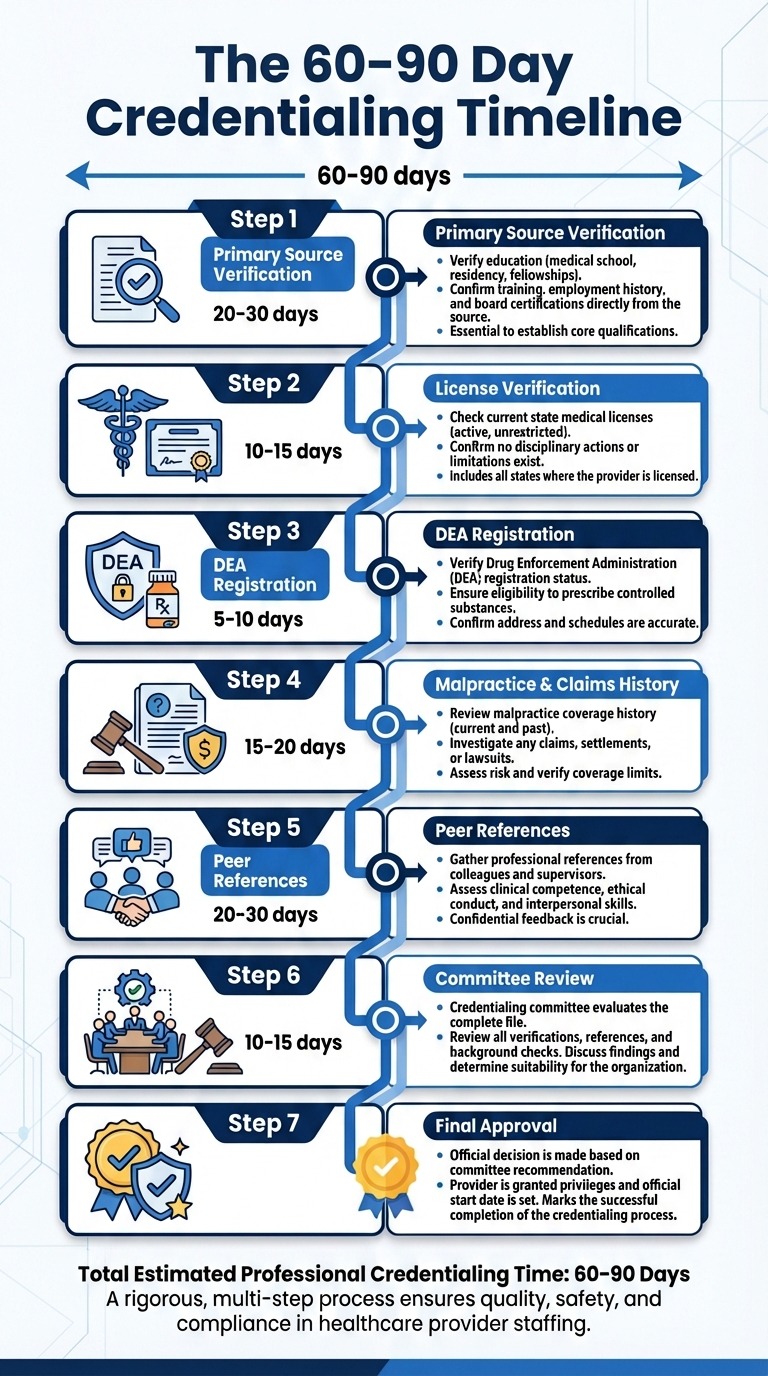
The National Association of Medical Staff Services (NAMSS) reports that the average physician credentialing process takes between 60 and 90 days from start to finish[2]. That's two to three months—and that's when everything goes smoothly.
Here's what those 60 to 90 days actually entail:
Primary source verification (20-30 days): Your credentialing specialist must verify medical school graduation, residency completion, and board certification directly from the original institutions. No shortcuts allowed—third-party verification services help, but the responsibility still rests on your shoulders.
License verification across states (10-15 days): Emergency physicians often hold licenses in multiple states. Each one requires verification, and state medical boards don't always respond quickly. Some physicians work in border communities and need licenses in two or three states, multiplying the workload.
DEA and controlled substance registration (5-10 days): Prescribing privileges require DEA verification and, in many states, additional controlled substance registration checks. These databases don't always sync seamlessly with your credentialing software.
Malpractice insurance and claims history (15-20 days): You must verify current coverage limits and query the National Practitioner Data Bank (NPDB) for any malpractice claims or adverse actions. NPDB responses can take two weeks or longer during busy periods.
Peer reference checks and work history (20-30 days): Contacting previous employers and peer references sounds straightforward—until you're chasing down busy physicians who take weeks to respond to your emails. Getting three solid references often requires contacting six or seven people.
Committee review and approval (10-15 days): Once you've compiled everything, the credentials committee must review the file. If your committee meets monthly, a physician who misses one meeting deadline waits another 30 days for approval.
Add it all up, and you're looking at a minimum of 60 days even with a dedicated credentialing specialist managing the process full-time.
The Medical Group Management Association (MGMA) estimates that each credentialing file costs hospitals between $3,000 and $5,000 in staff time and administrative overhead[3]. For a rural hospital credentialing 10 to 15 physicians annually (including re-credentialing), that's $30,000 to $75,000 in pure administrative expense before the physician ever sees a patient.
Sarah Chen, the Montana COO we met earlier, puts it bluntly: "We have one credentialing specialist managing 30 active physician files at any given time. When we need emergency coverage, the 90-day timeline means we're constantly scrambling. I spend hours each week tracking down missing documents, following up with references, and coordinating committee meetings. It's exhausting, and it pulls me away from strategic work that could actually grow our facility."
Scheduling: The Never-Ending Puzzle
If credentialing is a marathon, scheduling is a never-ending puzzle where the pieces keep changing shape.
Emergency departments require 24/7/365 coverage with no exceptions. That means someone must create schedules that account for:
- Provider availability and time-off requests (submitted months in advance)
- Last-minute call-offs due to illness or family emergencies
- Holiday coverage when everyone wants time off
- Shift preferences that keep physicians happy and prevent burnout
- Balancing full-time employed staff with locum tenens coverage
- Fair distribution of weekend and overnight shifts
Research from the Healthcare Financial Management Association (HFMA) found that hospital administrators spend an average of 8 to 12 hours per week managing ER scheduling alone[4]. That's one to two full workdays every single week—time spent sending emails, making phone calls, negotiating shift swaps, and updating spreadsheets.
And when something changes (which it always does), the cascade effect begins. One physician's sick day requires finding coverage, which might mean asking another physician to work overtime, which creates scheduling conflicts two weeks later, which leads to more adjustments, more emails, more stress.
Tom Mitchell, CEO of a critical access hospital in Wyoming, describes his pre-partnership reality: "Our HR director was spending 30 percent of her time on physician scheduling and credentialing combined. We were always behind, always playing catch-up. She'd barely finish next month's schedule before having to revise it because of changes. The constant firefighting meant we had no bandwidth for proactive initiatives."
Compliance: The Moving Target
As if credentialing and scheduling weren't complex enough, there's the ever-expanding universe of compliance requirements:
- Joint Commission standards for credentialing and privileging
- CMS Conditions of Participation that must be met for Medicare/Medicaid reimbursement
- State medical board requirements that vary by location
- Ongoing Professional Practice Evaluations (OPPE) that monitor physician performance continuously
- Focused Professional Practice Evaluations (FPPE) for newly privileged physicians or new procedures
- Re-credentialing cycles every two to three years that restart the entire verification process
Miss a re-credentialing deadline, and you face potential loss of Medicare reimbursement, accreditation risks, and significant liability exposure. The consequences of non-compliance aren't theoretical—they're real threats to your hospital's financial viability and reputation.
The cumulative effect of credentialing, scheduling, and compliance management creates what hospital leaders describe as "administrative quicksand." The harder you work, the deeper you sink. And all of this happens while you're trying to deliver excellent patient care, manage budgets, retain staff, and plan for the future.
So what's the solution? How are some hospitals cutting this burden by 40 percent?
The 40% Solution: Strategic Partnerships That Transform Administrative Burden
When hospital leaders hear "40 percent reduction in administrative work," they're often skeptical. It sounds too good to be true. But the math is straightforward—and the results are real.
What a 40% Reduction Actually Means
Let's make this concrete:
- If your team currently spends 20 hours credentialing each physician, a 40 percent reduction brings that down to 12 hours or less.
- If you spend 10 hours weekly on ER scheduling, you're now investing 6 hours.
- If compliance tracking consumes 15 hours monthly, it drops to 9 hours.
Those aren't small numbers. Across a year, reclaiming even 10 hours per week translates to more than 500 hours—the equivalent of adding a quarter-time employee without increasing payroll.
But where do these savings actually come from? The answer lies in understanding what strategic staffing partnerships actually provide.
How the Right Partnership Eliminates Administrative Burden
The keyword is "strategic." Not all staffing relationships offer the same level of administrative relief. Transactional staffing agencies simply provide names and resumes—you still handle all the credentialing, scheduling, and compliance work yourself.
Strategic partnerships, by contrast, fundamentally restructure the administrative workflow. Here's how:
1. Pre-Credentialed Physician Networks
When a staffing firm maintains its own credentialed physician network, the heavy lifting happens before you ever request coverage.
The firm's dedicated credentialing team—not your overstretched administrative staff—handles:
- Primary source verification for medical education and training
- License verification and ongoing monitoring across all states
- DEA and controlled substance registration tracking
- Malpractice insurance verification and claims history review
- Background checks and reference verification
- Continuous monitoring of expiration dates and proactive re-credentialing
When you request a physician from this pre-credentialed network, you receive a complete credential file ready for facility-specific privileging. Instead of starting from scratch with a 60 to 90-day timeline, you're completing the final privileging step—often in 30 to 45 days or less.
Sarah Chen, the Montana COO, experienced this transformation firsthand: "The first time Inspire sent us a physician, I opened the credential file expecting to see gaps I'd need to fill. Instead, everything was there—primary source verification, licenses, references, NPDB queries, the works. Our credentialing specialist just had to review it, and our committee could approve privileging within three weeks. It felt almost too easy after years of chasing down documents ourselves."
2. Turnkey Scheduling Management
Strategic staffing partners don't just provide physicians—they provide guaranteed coverage with built-in scheduling management.
Instead of your HR director spending 10 hours weekly juggling shift assignments, the staffing firm handles:
- All shift scheduling and coverage coordination
- Last-minute changes when physicians call in sick
- Backup coverage built into the contract (not your problem anymore)
- Holiday and vacation scheduling without gaps
- Shift preference management to keep physicians satisfied
You define your coverage needs—how many shifts per month, what days and times, any special preferences—and the staffing partner makes it happen. When a physician can't work a scheduled shift, the firm finds replacement coverage. You get consistent, reliable ER coverage without the administrative headaches.
Tom Mitchell, the Wyoming CEO, quantifies the impact: "Before partnering with Inspire, our HR director spent roughly 12 hours weekly on ER scheduling. Now she spends maybe 2 hours in monthly check-in meetings with our Inspire liaison. That's a reduction from 48 hours monthly to 2 hours—a 96 percent decrease in scheduling time. She's redirected that time to employee development programs and retention initiatives that are actually moving the needle on our workforce challenges."
3. Ongoing Compliance Management
Compliance isn't a one-time checklist—it's a continuous monitoring process. Strategic staffing partners employ credentialing specialists who handle:
- Tracking license, DEA, and insurance expiration dates
- Proactive re-credentialing before expiration
- Joint Commission and CMS requirement expertise
- Regular NPDB queries and CAQH profile updates
- Ongoing Professional Practice Evaluations (OPPE) support
- Documentation and reporting that satisfy accreditation standards
Your hospital still maintains oversight and final approval authority, but the day-to-day monitoring and paperwork management shifts to credentialing specialists whose full-time job is staying current with regulatory requirements.
This is where compliance risk reduction becomes tangible. When credentialing is someone's full-time specialty—rather than one of 15 competing priorities for your administrative staff—details don't slip through the cracks.

The Inspire Medical Staffing Difference: Physician-Owned Partnership
Not all staffing firms offer the same depth of administrative support. Large national agencies often operate transactionally—they send resumes and expect your team to handle credentialing and compliance. You might get physician names, but you're still drowning in paperwork.
Inspire Medical Staffing takes a fundamentally different approach because we're physician-owned and exclusively focused on rural emergency medicine. We understand the administrative burden firsthand, and our entire operational model is designed to eliminate it for hospital leaders.
Here's what that looks like in practice:
Comprehensive Credentialing Support
Every physician in Inspire's network maintains current, verified credentials managed by our dedicated credentialing team. We don't wait until you request coverage to start the credentialing process—we maintain continuous compliance for our entire physician pool.
When you partner with Inspire:
- You receive complete credential files ready for facility-specific privileging
- Our credentialing specialists serve as your liaison with state boards, NPDB, and verification services
- Re-credentialing happens proactively on our end, not yours
- Your credentialing timeline drops from 60-90 days to 30-45 days for facility privileging
This isn't just faster—it's fundamentally less stressful for your administrative team.
Guaranteed ER Coverage with Built-In Scheduling
Inspire doesn't just staff your ER—we guarantee 24/7 coverage with no gaps. Our team handles all scheduling logistics:
- Block scheduling, individual shifts, or hybrid models tailored to your needs
- Single point of contact for all coverage requests or changes
- Built-in backup physicians when unexpected absences occur
- Flexible adjustment as your coverage needs evolve
You define success (full ER coverage, physician quality, community fit), and we handle the operational details to make it happen. Your leadership team can finally stop thinking about next month's schedule and start thinking about next year's strategic plan.
Proactive Compliance Partnership
Our credentialing team doesn't just react to expiration notices—we monitor compliance proactively and communicate regularly with your team:
- Monthly compliance reports showing all credential status updates
- 90-day advance notice before any expiration dates
- Joint Commission and CMS expertise to ensure your hospital meets all requirements
- Responsive support when you have questions or need documentation
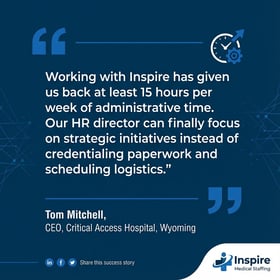
Tom Mitchell, the Wyoming CEO we heard from earlier, sums up the transformation: "Working with Inspire has been fundamentally different from other staffing relationships we've had. With previous agencies, we still handled most of the administrative work. With Inspire, they truly partner with us—they handle credentialing, scheduling, and compliance monitoring so we can focus on strategic leadership. We've reclaimed at least 15 hours per week of administrative time, which translates to real cost savings and better organizational focus."
What to Look for in a Talent Acquisition Partner
If you're convinced that the right partnership could reduce your administrative burden, the next question is: how do you evaluate potential staffing partners?
Not all firms offer the same level of support. Here are the key criteria that distinguish administrative burden relief from just another vendor relationship:
1. Dedicated Credentialing Infrastructure
Ask potential partners:
- "Do you have a dedicated in-house credentialing team, or do you outsource this function?"
- "What's your average timeline from hiring a physician to deployment at client facilities?"
- "What percentage of credentialing work do you handle versus what remains for our hospital?"
❗Red flag: Vague answers about timelines or "it depends" responses without specifics. Strong partners have clear processes and can articulate exactly what they handle.
2. Physician Network Quality and Retention
The best credentialing support in the world doesn't help if the physicians aren't qualified or don't stick around.
Ask:
- "What percentage of your physicians are board-certified in emergency medicine?"
- "What's your physician retention rate year-over-year?"
- "How many physicians in your network have rural ER experience?"
❗Red flag: High turnover rates or inability to provide retention statistics. Constant physician churn creates constant credentialing work—the opposite of administrative relief.
3. Scheduling Flexibility and Responsiveness
Coverage needs change. Your partner should adapt with you, not force you into rigid contract terms.
Ask:
- "How do you handle last-minute scheduling changes or physician call-offs?"
- "What's your typical response time when we need coverage adjustments?"
- "Can you provide short-notice coverage for unexpected gaps?"
❗Red flag: Inflexible scheduling models or slow response times. If they can't be responsive during the sales process, they won't be responsive after you sign.
4. True Partnership Approach
The best staffing relationships feel like partnerships, not vendor transactions.
Ask:
- "How often will we have check-in meetings to discuss coverage and address concerns?"
- "Who will be our primary point of contact, and will we have backup contacts?"
- "Can you share references from similar rural hospitals we can speak with?"
❗Red flag: Unwillingness to provide references or hesitation about ongoing communication. Strong partners are proud of their client relationships and happy to connect you with current hospital leaders.
5. Transparent Pricing and Contract Terms
Administrative relief only delivers ROI if the economics make sense for your budget.
Ask:
- "What's included in your quoted rate, and are there any additional fees?"
- "What are the contract terms, and what flexibility exists for adjusting coverage?"
- "How do you handle billing and invoicing to minimize our accounting workload?"
❗Red flag: Hidden fees, vague pricing structures, or overly complex contracts. Simplicity and transparency should extend to the business relationship, not just clinical coverage.
Making the Business Case Internally
You're convinced that a strategic staffing partnership could transform your administrative burden. Now you need to convince your board, your CFO, and your medical staff.
Here's how to build the business case:
For Your Board: Strategic Focus
Frame the conversation around leadership bandwidth and strategic opportunity cost.
"Currently, our administrative team spends approximately 35 to 40 percent of their time on physician credentialing and scheduling. That's time we can't invest in quality improvement initiatives, patient experience enhancements, or strategic growth planning. A strategic staffing partnership would reclaim hundreds of administrative hours annually—hours we could redirect to initiatives that improve patient outcomes and community reputation."
For Your CFO: ROI Calculation
Finance leaders want numbers. Give them specific calculations:
Current state:
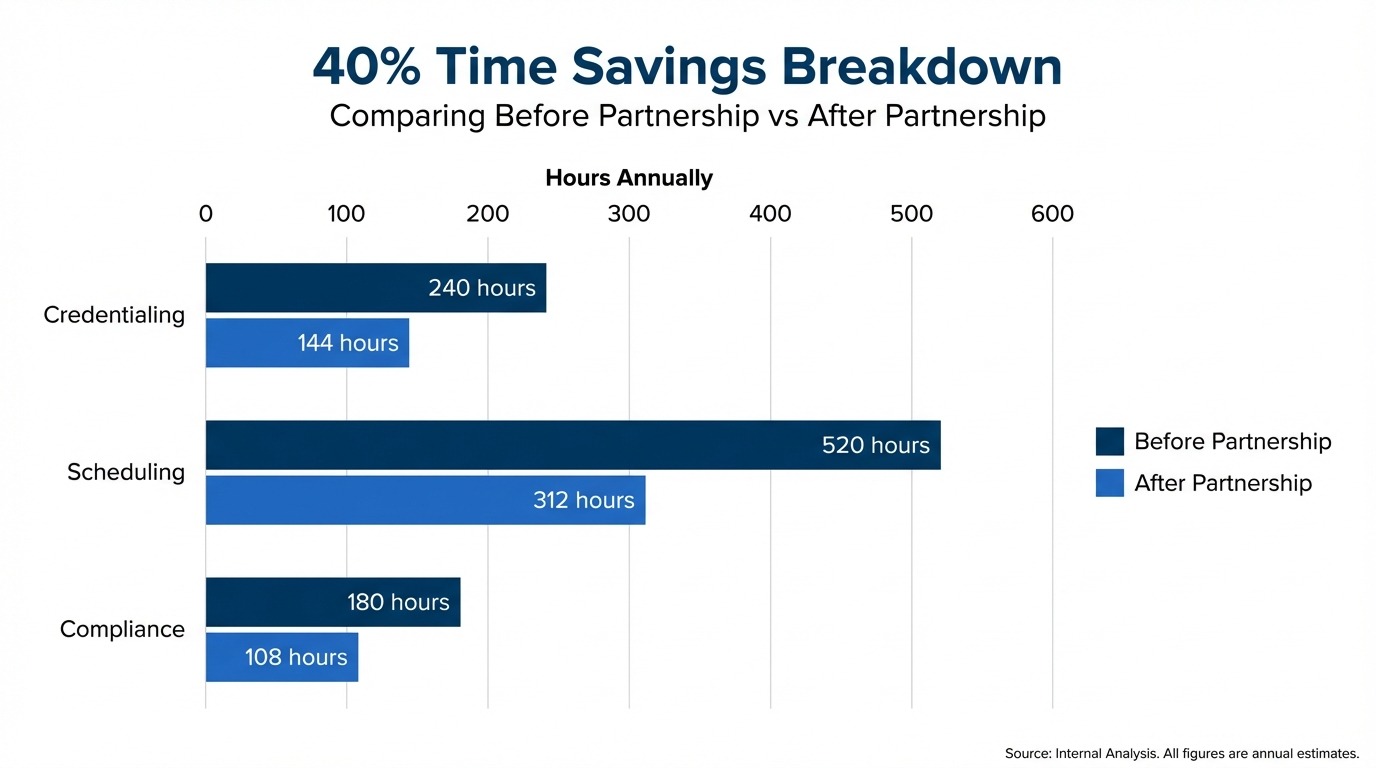
- 20 hours monthly per physician on credentialing × 12 physicians annually = 240 hours
- 10 hours weekly on ER scheduling × 52 weeks = 520 hours
- 15 hours monthly on compliance tracking × 12 months = 180 hours
- Total: 940 administrative hours annually
- At $45/hour average administrative cost: $42,300 annual expense
Projected partnership state (40% reduction):
- Credentialing: 144 hours (96 hours saved)
- Scheduling: 312 hours (208 hours saved)
- Compliance: 108 hours (72 hours saved)
- Total: 564 administrative hours annually
- At $45/hour: $25,380 annual expense
- Annual savings: $16,920 in administrative cost alone
This calculation doesn't even include avoided recruitment costs, reduced compliance risk, or the value of leadership time redirected to strategic initiatives. It's a conservative estimate that still shows meaningful ROI.
For Your Medical Staff: Quality and Continuity
Physicians often worry that staffing partnerships mean sacrificing quality or losing continuity of care.
Address these concerns head-on:
"We're partnering with a physician-owned staffing firm that specializes exclusively in rural emergency medicine. Their physicians are board-certified, experienced in rural settings, and committed to becoming part of our community. This partnership doesn't replace our medical staff—it supports them by ensuring we always have adequate ER coverage without the constant scheduling stress that leads to burnout. We'll maintain the same quality standards and privileging process we've always had."
Implementation: What to Expect
Once you've selected a partner and built internal support, what does implementation actually look like?
Here's a realistic timeline based on successful hospital partnerships:
Phase 1: Partnership Establishment (Weeks 1-4)
Your staffing partner will conduct a thorough needs assessment:
- Current ER coverage model and volume
- Scheduling preferences and shift patterns
- Credentialing requirements and committee processes
- Compliance standards and reporting needs
You'll finalize contract terms, establish communication protocols, and meet the physicians who'll be covering your ER. This phase is about alignment—making sure everyone understands expectations and success criteria.
Phase 2: Transition (Weeks 5-8)
Physicians from the staffing firm begin the facility-specific privileging process at your hospital. Because they arrive pre-credentialed, this moves quickly.
Your administrative team receives training on new processes: who handles what, how to request coverage changes, where to find compliance reports, and how to escalate concerns.
Expect frequent communication during this phase. Weekly check-ins help address questions and fine-tune the partnership before it becomes routine.
Phase 3: Optimization (Weeks 9-12)
The first few months reveal what's working well and what needs adjustment. Maybe the scheduling model needs tweaking based on actual patient volume patterns. Maybe communication frequency should increase or decrease based on hospital preferences.
This is when you start measuring results: How much administrative time have we actually saved? Are compliance reports meeting our needs? Is ER coverage as seamless as promised?
Phase 4: Ongoing Partnership (Month 4+)
By month four, the partnership should feel routine. Your ER has consistent coverage with minimal administrative involvement. Compliance reporting happens proactively. Your administrative team has redirected time to other priorities.
Quarterly strategic reviews keep the partnership aligned with your evolving needs. As your hospital grows or coverage requirements change, your staffing partner adapts with you.
Reclaim Your Time, Refocus Your Energy
Sarah Chen, the Montana COO we met at the beginning of this article, recently sent an email that crystallized the transformation:
"I left work at 5:30 PM yesterday—on a Friday. I can't remember the last time that happened. Our Inspire partnership has given me back not just hours in my week, but mental energy I didn't realize I'd lost. I'm no longer constantly thinking about credentialing deadlines and scheduling gaps. I'm thinking about our new cardiac rehab program and how we can improve post-discharge follow-up. It sounds dramatic, but partnering with Inspire hasn't just reduced administrative work—it's restored my ability to actually lead strategically instead of just managing operational crises."
That's what cutting administrative work by 40 percent actually looks like. It's not just about hours saved on a spreadsheet—it's about restoring your capacity to lead, to think strategically, and to invest energy in initiatives that truly move your hospital forward.
If you're spending too much time chasing credentialing documents, managing scheduling spreadsheets, and tracking compliance deadlines—time that could be better spent on strategic priorities—it's worth exploring what a partnership could mean for your facility.
The right staffing partner doesn't just fill shifts. They eliminate the administrative burden that's been weighing you down, so you can focus on what you do best: leading a hospital that delivers exceptional care to your rural community.
About Inspire Medical Staffing
Inspire Medical Staffing is a physician-owned emergency medicine staffing company dedicated exclusively to rural and critical access hospitals. Unlike large national staffing firms, Inspire operates with small local teams that understand the unique challenges of rural healthcare. Our physicians aren't just contractors—they're partners invested in the communities they serve.
We specialize in providing comprehensive ER coverage solutions that eliminate administrative burden for hospital leaders. From credentialing and scheduling to compliance management and ongoing support, Inspire handles the complexity so you can focus on strategic priorities.
Our mission is simple: deliver exceptional emergency care to rural communities while making hospital leaders' lives easier. We believe rural hospitals deserve the same quality of physician coverage as urban facilities—without the administrative headaches.
Ready to explore how Inspire can reduce your administrative burden by 40% or more? Contact our team to discuss your specific needs and learn how our partnership model can transform your ER coverage.
References
[1] Healthcare Financial Management Association (HFMA). (2024). Administrative Burden in Rural Hospitals: Time Allocation Study. HFMA Research Report.
[2] National Association Medical Staff Services (NAMSS). (2024). Credentialing Process Timeline Standards and Best Practices. NAMSS White Paper.
[3] Medical Group Management Association (MGMA). (2024). Cost Analysis of Physician Credentialing and Privileging Processes. MGMA DataDive Report.
[4] Healthcare Financial Management Association (HFMA). (2024). Time Study: Hospital Administrative Functions Including Scheduling and Workforce Management. HFMA Research Brief.
[5] The Joint Commission. (2024). Standards for Credentialing and Privileging in Hospitals. Joint Commission Resources.
[6] Centers for Medicare & Medicaid Services (CMS). (2024). Conditions of Participation: Medical Staff Requirements for Hospitals. 42 CFR §482.12.
[7] Rural Health Information Hub. (2024). Administrative Challenges in Rural Hospital Operations. RHIhub Topic Guide.
Disclaimer About Physician Scenarios:
The physician and hospital leader scenarios presented in this article (including Sarah Chen, Tom Mitchell, and their respective hospitals) are illustrative examples based on common experiences and challenges documented in healthcare administration research. While the situations and quotes reflect real patterns observed across rural hospitals, the specific names, locations, and details have been fictionalized to protect privacy and create relatable narratives. These scenarios are composites drawn from industry research, published case studies, and aggregated experiences rather than representing specific individuals or facilities.