

Chapters
Dr. Michael Torres will never forget the moment he realized everything had changed.
It was a Tuesday evening in his rural Montana emergency room when the ambulance brought in Mrs. Patterson—seventy-three years old, struggling to breathe, her oxygen saturation dropping. But this wasn't just another COPD exacerbation case number. This was Mrs. Patterson, the woman who had helped him find his favorite books in the elementary school library thirty years ago when his family briefly lived in this town. The woman whose grandson played on the same youth soccer team as his daughter. The woman he'd seen at the farmer's market just last Saturday, looking a bit more winded than usual.
In that moment, Dr. Torres understood the profound difference between his previous fifteen years in a Los Angeles County ER and his new role in rural emergency medicine. He wasn't just treating symptoms anymore—he was caring for someone whose story he knew, whose life intersected with his community, whose outcome would matter to him long after his shift ended.
If you're an emergency physician feeling lost in the volume of urban medicine, wondering if your work could have deeper meaning, or simply craving the "why I became a doctor" feeling again, rural emergency medicine offers something increasingly rare in modern healthcare: the opportunity for your impact to extend far beyond the exam room.
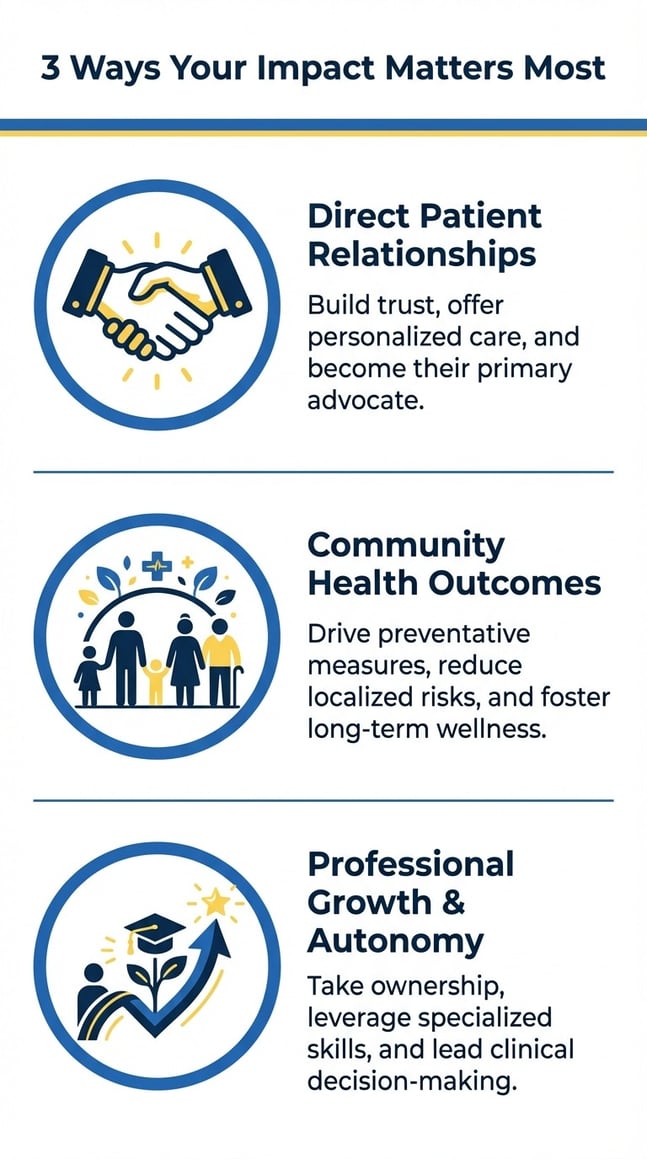
Let's explore the three ways your impact matters most in rural ER medicine—ways that transform not just patient outcomes, but your entire sense of purpose as a physician.
Way #1: Direct Patient Relationships Transform Care
The Urban-Rural Divide in Patient Connection
In most urban emergency departments, physicians encounter a relentless stream of unfamiliar faces. You might see 180 patients during a shift, spending an average of 8-12 minutes with each one. They arrive as cases—"the MI in bed 7," "the abdominal pain in triage"—and leave as discharge instructions handed to strangers you'll likely never see again.
The statistics are sobering: urban ER physicians report seeing the same patient more than once in less than 5% of encounters. You're providing excellent acute care, certainly, but there's no continuity, no context, no relationship.
Rural emergency medicine operates on an entirely different paradigm.
In rural settings, ER physicians typically see 40-60% of the same patients repeatedly over time. You become their trusted healer, not a random doctor they happened to get that night. You know their medical histories not from scrolling through an EHR, but because you were there for their gallbladder surgery last year, their daughter's broken arm, their husband's heart attack.
Dr. Torres's Transformation Story
When Dr. Torres made the transition from Los Angeles to Montana two years ago, his initial concern was professional isolation. "I worried I'd lose my clinical edge seeing only 25-35 patients per shift instead of 180," he admits. "I thought smaller volume meant smaller impact."
He was wrong.
That evening with Mrs. Patterson crystallized the difference. Because he knew her—really knew her—his clinical approach changed entirely. He didn't just treat her oxygen saturation number. He knew she lived alone in a house with stairs. He knew she was fiercely independent and would minimize symptoms to avoid "being a burden." He knew her daughter lived two hours away and couldn't check on her daily. He knew she'd struggled with medication compliance because she confused her inhalers.
"In LA, I would have treated her acute episode, arranged admission, and moved on to the next patient," Dr. Torres reflects. "Here, I could address the whole picture. I called her daughter while treating her. I arranged for a home health evaluation. I simplified her medication regimen because I knew what would actually work for her specifically. I made sure she understood this wasn't about being a burden—it was about me wanting my daughter's soccer game buddy to be healthy."
Mrs. Patterson went home two days later with a completely restructured care plan. More importantly, she actually followed it because it came from "Dr. Mike," someone she trusted, who took time to explain things in her kitchen at a follow-up visit the next week.
"Three months later, she hasn't been back to the ER once," Dr. Torres says. "In the city, she would have been a frequent flyer. Here, I actually solved her problem because I could treat the whole person, not just the acute episode."
The Clinical Benefits of Relationship-Based Care
The research supports what Dr. Torres experienced. Studies published in the Journal of Rural Health demonstrate that rural emergency departments with strong physician continuity see:
- 15-20% lower readmission rates for chronic conditions like COPD, CHF, and diabetes complications
- Significantly higher medication compliance rates (up to 30% higher) when patients have an established relationship with their ER physician
- Earlier intervention for deteriorating chronic conditions because patients trust "their doctor" enough to come in before crises develop
- Better mental health integration, as rural ER physicians are more likely to recognize depression, substance abuse, and trauma in patients they know personally
This isn't just about feeling good—it's about delivering genuinely better care because you have context, trust, and continuity that urban emergency medicine simply cannot provide.
The Emotional Reward
There's another dimension to patient relationships that matters profoundly to physician well-being: emotional fulfillment.
When you practice relationship-based rural emergency medicine, you see the long-term outcomes of your interventions. You watch the overdose patient you saved get sober and turn their life around. You see the teenager whose appendicitis you caught early graduate from high school. You get thanked at the hardware store by the father whose daughter you stabilized before helicopter transport.
"Last month, a patient brought me homemade jam to thank me for taking care of his wife during her stroke," Dr. Torres shares. "That would never happen in an urban ER—they wouldn't even remember which doctor treated them. Here, I'm not just a physician. I'm their physician. That matters more than I ever imagined it would."
Way #2: You Shape Community Health Outcomes
The Ripple Effect of Rural ER Physicians
In urban medical systems, you're one physician among hundreds. Your hospital has cardiologists, pulmonologists, endocrinologists, infectious disease specialists, psychiatrists—an entire ecosystem of specialty care.
In rural areas, the emergency physician is often the only specialty care readily available to the community. Your decisions don't just affect individual patients—they influence population health outcomes for the entire region.
This reality transforms your role from acute care provider to community health leader.
Research from the National Rural Health Association demonstrates that rural hospitals with stable emergency physician staffing see approximately 30% better chronic disease management outcomes in their communities compared to facilities with high physician turnover. When you stay, when you invest, when you become part of the community fabric, everything improves.
Dr. Jennifer Huang's Community Impact Story
Dr. Jennifer Huang discovered this truth in an unexpected way during her second year practicing pediatric emergency medicine in rural Wyoming.
She began noticing a pattern: every September and October, her ER filled with children experiencing acute asthma exacerbations. The spike was dramatic—three to four times the baseline. In her previous position at a Denver children's hospital, she would have simply treated each case and moved on.
But here, she knew these kids. She knew their families. She saw them at school events and community gatherings. The pattern bothered her not as an interesting clinical observation, but as a failure to protect children she cared about.
Dr. Huang started investigating. She talked to parents, reviewed environmental data, consulted with the local health department, and spoke with agricultural extension agents. She discovered the spike correlated precisely with fall harvest practices—specifically, the burning of agricultural waste that sent particulate matter and allergens through the small town where most of her patients lived.
In an urban setting, this observation might have ended with a case report or a research paper. In rural Wyoming, Dr. Huang had the standing and relationships to actually do something about it.
She presented her findings to the school board, the town council, and local farmers' cooperative. She partnered with the county health department to create an asthma action plan for schools. She worked with farmers to adjust burning schedules and explore alternative practices. She organized an asthma education program for parents and teachers.
The results were remarkable: over the next 18 months, pediatric asthma-related ER visits during harvest season dropped by 40%. Children missed fewer school days. Parents missed less work. The entire community benefited from one physician who cared enough to look beyond individual cases to population health.
"In Denver, I treated asthma attacks—hundreds of them," Dr. Huang reflects. "In Wyoming, I helped prevent them. That's the difference between being a cog in a large system and being essential to a small community. I'm not just practicing medicine here. I'm shaping the health of an entire generation of kids I actually know."
Measurable Population Health Improvements
Dr. Huang's experience isn't unique. Rural emergency physicians across the country report similar opportunities to influence community health:
- Vaccination rates improve when trusted ER physicians advocate for immunizations during patient encounters and community events
- Opioid overdose deaths decrease in communities where ER physicians lead medication-assisted treatment programs and community education initiatives
- Diabetes management improves when ER physicians provide consistent patient education and coordinate with primary care (which may also be limited in rural areas)
- Mental health crisis outcomes improve when ER physicians build relationships with patients, schools, and law enforcement to create better intervention pathways
The Mission Factor
Perhaps the most powerful aspect of this community-level impact is what it does for physician satisfaction and sense of purpose.
The Physicians Foundation's 2022 survey found that rural emergency physicians report 85% higher "sense of purpose" scores compared to their urban counterparts. When asked to explain the difference, the most common response was simple: "I feel essential here, not replaceable."
That distinction matters profoundly. In urban medicine, you're one provider in a massive system. If you leave, someone fills your spot within weeks. The system continues unchanged.
In rural emergency medicine, you are part of the community fabric. Your presence, your expertise, your relationships—they matter. Parents know your name. Elderly patients ask for you specifically. Community leaders seek your input on health initiatives. You're not an employee; you're a cornerstone.
"I didn't realize how much I needed to feel needed until I found it here," Dr. Huang admits. "This sense of mission, of being genuinely essential to my community's health—it's what medicine is supposed to feel like."
Way #3: Professional Growth Through Clinical Autonomy
Broader Scope of Practice
One of the most surprising discoveries physicians make when transitioning to rural emergency medicine is the expansion of their clinical scope and decision-making authority.
In urban academic centers and large community hospitals, protocols are rigid, specialist backup is immediate, and your role is often narrowly defined. There's a pulmonologist for respiratory cases, a cardiologist for chest pain, an orthopedic surgeon for fractures. You stabilize, you consult, you admit.
Rural emergency medicine demands—and rewards—broader clinical capabilities and greater autonomy.
Dr. Torres describes the difference: "In LA, if a patient needed a chest tube, I'd call surgery. Here, I'm surgery until the patient can be transferred. I'm doing procedures I hadn't performed in years—fracture reductions, complex laceration repairs, advanced airway management, ultrasound-guided procedures. My clinical skills have actually expanded, not atrophied."
This isn't about practicing beyond your competence—rural physicians have robust telemedicine specialist support and clear transfer protocols for cases beyond hospital capabilities. But within that framework, you have significantly more opportunity to utilize your full skill set and make independent clinical decisions.
Decision-Making Authority and Leadership
Rural emergency physicians also discover unexpected leadership opportunities.
Because hospitals are smaller and physician pools are limited, ER doctors in rural settings frequently take on roles that would be reserved for administrators or department chairs in larger systems:
- Medical Director positions with genuine authority over protocols, staffing, and quality improvement
- Quality improvement leadership, shaping how the entire emergency department functions
- Community health program development, designing initiatives that extend far beyond the ER
- Mentorship roles for new graduates, PAs, NPs, and rotating medical students
"Within six months of arriving in Montana, I was invited to join the hospital quality committee," Dr. Torres shares. "Within a year, I became medical director of the emergency department. I actually have a voice in how we practice medicine here. In LA, I was one of forty ER physicians. My input meant nothing. Here, my experience and ideas shape how we deliver care."
This level of professional respect and authority is deeply satisfying for physicians who feel powerless in large systems where decisions are made by administrators who've never treated a patient.
Continuous Learning Environment
Paradoxically, many rural ER physicians report that their clinical knowledge actually expands in rural practice, despite being further from academic medical centers.
Why? Because every shift challenges your full skill set. You can't rely on immediate specialist consultation for every complex case. You become adept at telemedicine collaboration, thoroughly researching unfamiliar presentations, and thinking comprehensively rather than narrowly.
"I read more medical literature now than I did at my urban hospital," Dr. Huang notes. "When you're the only physician available for complex cases, you make sure you're up to date. Telemedicine brings me access to specialists across the country—I'm learning from Mayo Clinic pulmonologists and Cleveland Clinic cardiologists via video consultation. My learning hasn't stopped; it's intensified."
Additionally, rural physicians often report having the time and mental energy for professional development that was impossible in high-volume urban settings:
- Time to actually read journal articles between patients
- Energy to attend virtual conferences and CME activities
- Mental space for thoughtful reflection on cases rather than survival mode
- Bandwidth for pursuing quality improvement projects and research
Work-Life Balance as Professional Development
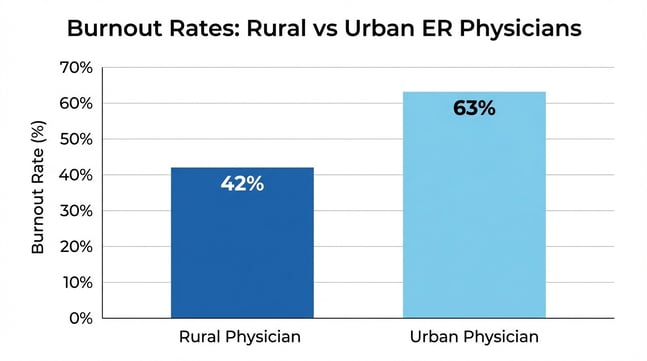
Perhaps most importantly, rural emergency physicians consistently report better work-life balance—and that balance directly contributes to professional longevity and growth.
The statistics are compelling:
- Burnout rates: 42% among rural ER physicians vs. 63% among urban ER physicians (American College of Emergency Physicians, 2023)
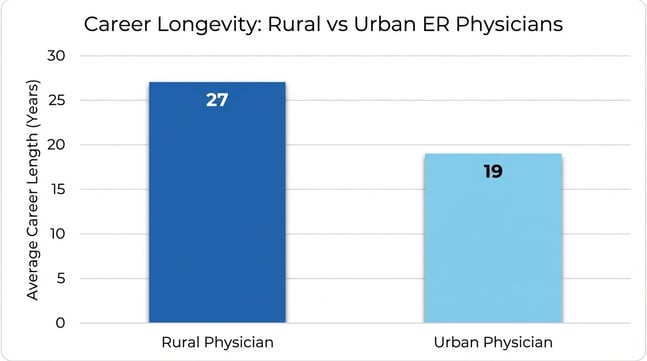
- Average career length: 27 years in rural practice vs. 19 years in urban practice
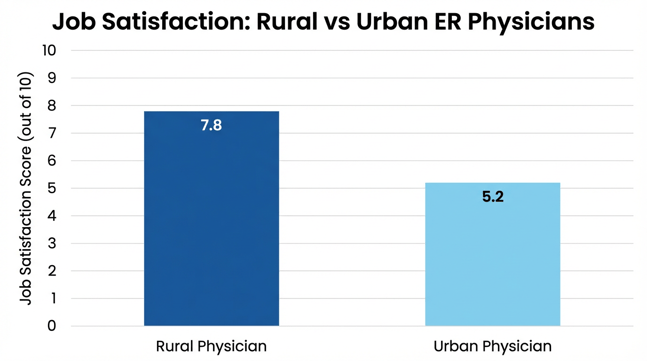
- Job satisfaction scores: 7.8/10 in rural settings vs. 5.2/10 in urban settings (Physicians Foundation Survey, 2022)
Why the dramatic difference? Rural physicians cite several factors:
- Reasonable patient volumes that allow for thorough care without constant time pressure
- Predictable schedules with consistent shift patterns rather than chaotic coverage
- Community integration that makes you feel like a valued member, not just an employee
- Meaningful work that provides emotional fulfillment rather than just a paycheck
"I have time to mountain bike three mornings a week now," Dr. Torres says. "I coach my daughter's soccer team. I'm home for family dinners. I'm not just a better doctor because I'm less burned out—I'm a better person. And that makes me better at medicine. I have the energy to care, to think, to grow professionally instead of just surviving."
This sustainable practice model means rural ER physicians can maintain high-quality care throughout longer careers, continuously developing their skills without the burnout that drives so many urban physicians out of clinical practice entirely.
The Practical Reality Check
Honest Assessment of Challenges
Rural emergency medicine isn't without challenges, and honest physicians acknowledge them:
- Limited on-site specialty resources: You won't have an interventional cardiologist in-house. Complex subspecialty care requires telemedicine consultation or patient transfer.
- Occasionally higher acuity-to-resource ratios: When multiple critical patients arrive simultaneously, you're managing with a smaller team and more limited resources than a large urban center.
- Broader knowledge requirements: You need comfortable familiarity with a wider range of conditions since specialist backup isn't immediately available.
- Comfort with uncertainty: Rural emergency medicine demands tolerance for managing complex cases with telephonic specialist guidance rather than in-person consultation.
However, most rural ER physicians emphasize that these challenges are manageable—and often overestimated by physicians accustomed to urban practice.
Support Systems That Make It Work
Modern rural emergency medicine includes robust support systems:
- Telemedicine specialist backup: 24/7 access to specialists across virtually every discipline via video consultation. Many rural physicians report that telemedicine specialist access is actually better than in-person consultations because you can reach top specialists nationwide, not just whoever is on call locally.
- Air ambulance transfer networks: Efficient, established protocols for transferring patients requiring tertiary care to regional medical centers, typically within 60-90 minutes.
- Strong interprofessional teams: Rural ER nurses, paramedics, and advanced practice providers are highly skilled and collaborative. The team culture is typically much stronger than in high-turnover urban environments.
- Peer support networks: Organizations like the National Rural Health Association and state-level rural physician networks provide professional community, continuing education, and peer support.
- Continuing education resources: Virtual CME, online specialty consultations, and professional development opportunities are specifically designed for rural practitioners.
Financial Considerations
Rural emergency medicine is also financially competitive—often more lucrative than urban positions when you account for the full picture:
- Competitive base salaries: Rural ER physician compensation frequently matches or exceeds urban salaries due to recruitment challenges and high demand.
- Loan repayment programs: National Health Service Corps (NHSC), state-level loan repayment programs, and facility-specific loan assistance can eliminate $50,000-$150,000 in medical school debt.
- Lower cost of living: Housing, childcare, and general living expenses are dramatically lower in rural areas, meaning your real income (purchasing power) is often 30-50% higher than comparable urban salaries.
- Quality of life return: Shorter commutes, less time in traffic, access to outdoor recreation, and stronger community connections provide lifestyle value that's difficult to quantify but profoundly meaningful.
Dr. Torres puts it simply: "I make slightly more here than in LA, my house cost one-third as much, I have zero commute, and I'm home for my family. The financial equation isn't even close."
Taking the First Step
Is Rural ER Medicine Right for You?
If you're considering rural emergency medicine, reflect honestly on these questions:
Do you miss the "why I became a doctor” feeling? Rural practice reconnects you with the mission and purpose that likely drew you to medicine initially.
Do you want to know your patients' names and stories? If relationship-based care energizes you, rural medicine provides that in abundance.
Does community connection matter to you? If you want to be part of a community fabric rather than just an employee in a large system, rural practice offers genuine belonging.
Are you ready for broader clinical challenges? If expanding your scope of practice and clinical autonomy appeals to you, rural emergency medicine provides opportunities unavailable in urban settings.
Is work-life balance important? If you're burned out, exhausted, or feeling like medicine is consuming your life, rural practice offers sustainable career models with time for family, hobbies, and personal well-being.
If you answered "yes" to several of these questions, rural emergency medicine deserves serious consideration.
The Inspire Medical Difference
Not all rural opportunities are created equal. The staffing model, support structure, and partnership approach matter enormously.
Inspire Medical Staffing is physician-led and physician-focused. That means:
- Personalized placement matching: We take time to understand your specific goals, lifestyle priorities, and practice preferences. We're not just filling slots—we're matching physicians with communities where they'll thrive.
- Comprehensive support throughout transition: From credentialing to community integration, we ensure you have the resources and guidance to succeed.
- Ongoing professional development: We invest in our physicians' long-term growth with CME support, telemedicine resources, and peer networking.
- Your voice matters: As a physician-owned organization, we prioritize what actually matters to clinicians, not just administrators. Your experience and input shape how we operate.
Your Impact Awaits
Rural emergency medicine offers something increasingly rare in modern healthcare: the opportunity to practice medicine the way you imagined it when you decided to become a doctor.
You'll build relationships with patients whose names you know, whose families you recognize, whose lives intersect with yours in meaningful ways. You'll shape community health outcomes, not just treat individual cases. You'll grow professionally through expanded clinical autonomy, leadership opportunities, and sustainable practice that doesn't burn you out.
Your impact in rural emergency medicine isn't just about the lives you save in the moment—it's about becoming a pillar of health and hope for an entire community that genuinely needs you.
If that vision resonates, if you feel that pull toward deeper purpose, take the first step: have a conversation with Inspire Medical Staffing.
Learn about opportunities where your skills, your values, and your desire for meaningful impact align with communities that will welcome you not as an employee, but as an essential part of their health and future.
Contact Inspire Medical Staffing to start a conversation about rural emergency medicine opportunities tailored to your goals and lifestyle.
Your next chapter in medicine—the one where your impact matters most—is waiting.
Disclaimer
The physician scenarios described in this article (Dr. Michael Torres and Dr. Jennifer Huang) are fictional composites created for illustrative purposes. While the names and specific details are fictionalized, the experiences, challenges, and outcomes described are based on common experiences reported by emergency physicians transitioning to rural practice settings. The statistics and research cited are from authentic published sources.
About Inspire Medical Staffing
Inspire Medical Staffing is a physician-led medical staffing and recruitment firm dedicated to connecting exceptional healthcare providers with meaningful opportunities in emergency medicine and hospital-based specialties.
Our Mission: We exist to improve healthcare access in underserved communities by partnering with physicians who seek purpose-driven careers where their impact truly matters.
Whether you're exploring rural emergency medicine for the first time, seeking a change from urban practice, or looking for opportunities that align with specific lifestyle goals, our team is ready to help you discover where your skills and passion can make the greatest impact.