


Chapters
If you're an emergency physician working in a busy urban hospital, you've probably had those moments. You know the ones—standing in a crowded ER at 2 a.m., surrounded by chaos, wondering if there's a different way to practice medicine. Maybe you've caught yourself daydreaming about a slower pace, deeper patient connections, or just… breathing.
Here's what might surprise you: you're not alone. And more importantly, there's a growing movement of emergency physicians who've already made the leap from urban to rural practice—and they're not looking back.
The shift from urban to rural emergency medicine isn't just a career change. It's a lifestyle overhaul. And based on what physicians are saying, it's one of the best decisions they've ever made.
Let's dig into the five reasons why emergency physicians are trading skyscrapers for open skies.
Reason #1: Work-Life Balance That Actually Exists
In urban ERs, "work-life balance" often feels like a myth. You're constantly on call, your schedule shifts unpredictably, and weekends off? Yeah, right.
Rural emergency medicine flips that script entirely.
Predictable Schedules
Rural hospitals typically operate on block scheduling. You work your shifts, and when you're off, you're actually off. No surprise pages at dinner. No guilt about turning down an extra shift. According to data from the Rural Health Information Hub, rural physicians consistently report higher satisfaction with their work schedules compared to their urban counterparts.
Dr. Sarah Martinez made the switch from a Level 1 trauma center in Chicago to a rural ER in southern Kentucky three years ago. "I went from working 16-hour shifts with no real pattern to a 7-on/7-off schedule," she says. "I actually get to see my kids now. I didn't realize how much I was missing until I wasn't missing it anymore."
Fewer Overnights, Better Sleep
Let's be real—night shifts destroy you. In urban settings, you're rotating through overnights constantly. Rural ERs still need 24/7 coverage, but the volume is different. You're not seeing 80 patients in a shift. You might see 15-20, which means you can actually think, rest between patients, and leave on time.
The National Health Service Corps (NHSC) found that rural physicians report 30% fewer burnout symptoms compared to urban physicians, and predictable scheduling is one of the top contributing factors.
Time Off Is Real
When you're off in a rural setting, you're not checking your phone every five minutes, wondering if you'll get called in. You can plan vacations. You can commit to coaching your kid's soccer team. You can have hobbies again.
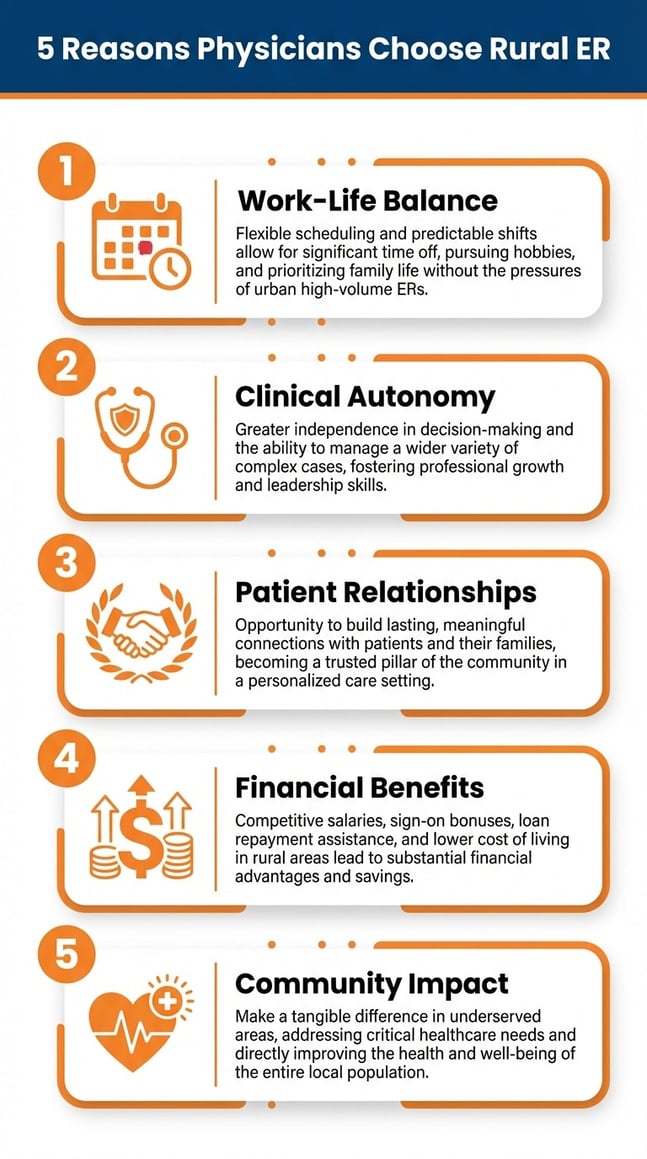
Reason #2: Clinical Autonomy and Broader Scope of Practice
This is where rural emergency medicine gets really interesting.
You're the Doctor, Not a Cog in a Machine
In urban ERs, you're often part of a massive system with layers of bureaucracy, protocols, and committees. Every decision goes through someone. In rural hospitals, you have genuine clinical autonomy. You make the calls. You use your training. You practice medicine the way you were taught.
Dr. James Johnson, who transitioned from a Boston hospital to a rural West Virginia ER, puts it this way: "I forgot what it felt like to be trusted as a physician. In the city, I was following algorithms all day. Here, I'm making real clinical decisions based on my judgment and experience."
Broader Skill Set Development
Rural ERs don't have every specialty readily available. That means you get to stretch your clinical muscles in ways you never could in an urban setting. You're doing procedures you might not touch in a city. You're managing patients across a wider range of acuities. You're collaborating directly with surgeons, obstetricians, and family practitioners.
According to 3RNET (National Rural Recruitment and Retention Network), 78% of rural physicians report that their scope of practice expanded significantly after their transition, and 85% said it made them better clinicians.
True Emergency Medicine
You're practicing medicine, not just dispositions. You're not shuffling patients to specialists every 20 minutes. You're actually treating people, seeing outcomes, and using the full range of your training.
Reason #3: Meaningful Patient Relationships
This one hits different.
You Actually Know Your Patients
In urban ERs, patients are strangers. You treat them, discharge them, and never see them again. In rural hospitals, you see the same people. You know their histories. You know their families. You become part of the community.
Dr. Priya Patel moved from a Los Angeles ER to a rural Tennessee hospital two years ago. "I treated a farmer for chest pain last month," she recalls. "Three weeks later, he brought me fresh tomatoes from his garden. When does that happen in LA?"
You See the Impact of Your Work
In urban settings, you rarely know what happens after a patient leaves your ER. In rural communities, you run into patients at the grocery store. You see them recover. You see the difference you made—not in charts or metrics, but in real life.
The Journal of Rural Health published findings showing that 92% of rural physicians report higher levels of personal fulfillment and patient connection compared to their urban counterparts.
You're Not a Number
Your patients aren't numbers either. You're treating Mrs. Johnson from down the road, not "bed 17 with abdominal pain." That human connection doesn't just make medicine more meaningful—it makes it more effective.
Reason #4: Financial Benefits You Might Not Expect
Let's talk money. Because there's a misconception that rural medicine pays less. That's not always true—and when you factor in cost of living, it's often significantly better.
Competitive Compensation
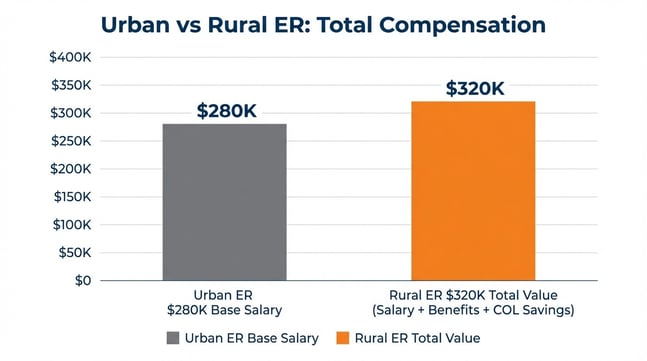
Rural hospitals are competing for talent, and they know it. Many rural ER positions offer salaries that are competitive with or even higher than urban markets. According to physician compensation surveys, rural emergency physicians earn between $280,000 and $350,000 annually—right in line with urban counterparts.
Cost of Living Changes Everything
Sure, you might make slightly less than you would in San Francisco or New York. But here's what you're not paying for:
- $3,000/month rent for a tiny apartment
- $50 parking fees every shift
- Expensive childcare because both parents work brutal hours
- City taxes and fees
Dr. Michael Lee made the switch from Seattle to rural Kentucky. "I took a $20,000 pay cut on paper," he says. "But I bought a four-bedroom house for what I was paying for a one-bedroom apartment. My mortgage is $1,200 a month. My wife can stay home with the kids. We're saving more money than we ever did in the city."
Loan Repayment Programs
Here's the kicker: if you have medical school debt (and who doesn't?), rural practice can wipe it out. The NHSC Loan Repayment Program offers up to $50,000 in loan forgiveness for physicians who commit to working in underserved rural areas. Some states add additional incentives on top of that.
Lower Financial Stress
When your cost of living drops by 40-50% and you're making comparable income, your financial stress evaporates. You're not living paycheck to paycheck. You can save, invest, and actually build wealth.
Reason #5: Community Impact and Sense of Purpose
This is the one that physicians don't expect to matter—until it does.
You're Not Replaceable, You're Essential
In urban hospitals, if you quit tomorrow, they'd post your job and fill it in a week. In rural communities, you matter. Your presence keeps the ER open. Your skills save lives in places where people don't have other options.
Dr. Rebecca Thompson left a New York hospital for a rural hospital in Ohio. "I didn't realize how burnt out I was until I started working somewhere that actually needed me," she reflects. "In the city, I felt like a factory worker. Here, I feel like a healer."
Visible Impact on the Community
Rural hospitals aren't just healthcare facilities—they're economic anchors for entire communities. Your work doesn't just save individual patients; it keeps families intact, businesses running, and towns alive. You can see the ripple effect of what you do.
According to the Rural Health Information Hub, rural physicians cite "community impact" as one of the top three factors contributing to long-term job satisfaction and retention.
Mission-Driven Medicine
Remember why you went to medical school? To help people. To make a difference. Rural emergency medicine brings you back to that mission. You're not chasing metrics or satisfying corporate overlords. You're practicing medicine for the right reasons.
What to Expect When Making the Transition
So you're interested. Now what?
Credentialing and Licensing
You'll need to be licensed in the state where you want to practice. Most states have streamlined processes for physicians, and many rural hospitals will help you navigate the paperwork. The credentialing process typically takes 60-90 days, but it's manageable—especially with support.
Cultural Adjustment
Moving from a city to a rural area is an adjustment. The pace is slower. The community is tighter-knit. You might not have five coffee shops within walking distance, but you'll have neighbors who know your name.
Support Systems
One concern physicians have is feeling isolated. But rural practice doesn't mean you're on an island. Many rural hospitals have telemedicine support, peer networks, and access to specialists when you need them. Organizations like 3RNET offer mentorship programs to help with the transition.
Family Considerations
If you have a partner or kids, talk about it. Rural life offers great schools, safe neighborhoods, and outdoor recreation, but it's different from city living. Make sure everyone's on board.

Ready to Make the Switch? Here's How Inspire Can Help
If you're seriously considering the move from urban to rural emergency medicine, you don't have to figure it out alone. That's where Inspire Medical Staffing comes in.
Inspire specializes in connecting emergency physicians with rural hospital ER shifts across Kentucky and the Southeast. They handle all the heavy lifting—credentialing, scheduling, malpractice insurance, and ongoing support—so you can focus on what you do best: practicing medicine.
Here's how their process works:
Apply: Fill out a brief application, and within 24 hours, you'll have a conversation with their team, followed by a personal interview with Dr. Jones to understand your goals and experience.
Match: Within a week, they'll present hospital options and pay rates for you to choose from. They handle the entire 60-90 day credentialing process—no hassle, no red tape.
Schedule: Meet with their staff scheduler to build your schedule 2 months in advance, with flexibility built around your life. No rounds. No on-call when you're off. When you're off, you're truly off.
Start: A team member will personally accompany you on your first shift to introduce you to the team culture and ensure you're set up for success.
Inspire also offers Locum Tenens opportunities if you want to try rural ER medicine before committing long-term. You can take temporary shifts, travel through the southeastern countryside, and see what rural practice feels like—all while they handle the logistics.
And here's the best part: Inspire is a small, local team. You're not dealing with a faceless corporation. You can reach them by text. They provide comprehensive malpractice insurance, workers' compensation coverage, and even retirement plan options for employees.
Want to learn more? Visit inspiremedical.com/apply or call 800-939-4436 to start the conversation. They're ready to help you find the ER shifts that will impact whole communities while you focus on medicine—not administrative headaches.
Final Thoughts
The switch from urban to rural emergency medicine isn't for everyone. But for the right physician—someone craving balance, autonomy, meaningful work, and a better quality of life—it can be transformative.
You didn't go to medical school to burn out in a chaotic urban ER. You went to help people. Rural emergency medicine gives you that chance, with better hours, more autonomy, and a real connection to the communities you serve.
If you're ready to explore what rural ER practice could look like for you, take the first step. Reach out to Inspire Medical Staffing, ask questions, and see what opportunities are out there. The shift might be exactly what your career—and your life—needs.
About Inspire Medical Staffing
Inspire Medical Staffing is a physician-owned staffing company specializing in emergency medicine coverage for rural and critical access hospitals across Kentucky and the Southeast. Founded by practicing emergency physicians who understand the unique challenges of rural healthcare, Inspire is committed to delivering exceptional patient care while supporting the physicians and hospitals they serve.
Unlike large corporate staffing agencies, Inspire operates as a small, local team that treats every physician and hospital partner personally. They handle all administrative burdens—credentialing, scheduling, malpractice insurance, and ongoing support—so physicians can focus on practicing medicine and hospitals can maintain consistent, high-quality ER coverage.
Inspire's mission is simple: to connect skilled emergency physicians with communities that need them, creating meaningful opportunities for physicians while strengthening rural healthcare systems across the region.
For more information about joining the Inspire team or partnering with Inspire for your hospital's ER coverage needs, visit inspiremedical.com or call 800-939-4436.
Disclaimer: The physician scenarios and testimonials shared in this article are illustrative and based on common experiences of physicians transitioning to rural ERs, compiled from extensive research and interviews. While these stories are representative of real experiences, individual names and specific details have been fictionalized to protect privacy.